
Exams are marked, the marks are in, it's all over but the unearthing of my desk from beneath the mountains of accumulated papers (VPs take note: I need Friday afternoon preps for desk-cleaning purposes because otherwise it will never get done). And we're back on track for this challenge.
Hem. I may have taken the concept of overkill to new heights, here.
You will not be surprised to hear that I read Mr. Darcy's Diary in March (when I was supposed to be reading that other book), but when I found out that Amanda Grange had written about a billion more P&P books, I put off reviewing it until I had read them*, which I didn't want to do until school ended. They were pretty quick reads, especially the last three. I'm covering five books, so this review is going to be really long, even by my standards.
Are you all sitting comfortably? Then I'll begin.
 |
| Image source: austenprose.com |
I thought Grange did a better job of it than Aiden did. Far fewer exclamation points, for one thing. She captures his haughtiness very well, and I think she manages to capture some of the language.
A smile lit her eyes, and turning towards me, she said:This Elizabeth is no paragon, thank heavens. Grange does a very good job of showing Darcy disdaining her at first, then slowly coming to the point where he can't stop thinking about her. In the parts where the novel takes over, I was vaguely disappointed at first. Grange would start with some of the original dialogue, but then that was all we would get, and I was left feeling "And? So? Why did you say that?" Since the book begins before P&P, and Grange is so good at imagining the conversations and explaining why he says certain things, it felts empty. After a while, though, this stops being a problem and Grange does give us Darcy's thoughts.
‘Mr Darcy is all politeness.’
It was a challenging smile; there was no doubt about it. Although she said that I was all politeness, she meant the reverse. I felt my desire to dance with her grow. She had set herself up as my adversary, and I felt an instinct to conquer her rise up inside me.
Why had she refused me? Because she had overheard me saying that she wasn’t handsome enough to tempt me at the Meryton ball? Of course! I found myself admiring her spirit. My ten thousand pounds a year meant nothing to her when compared with her desire to be revenged on me.
I watched her walk away from me, noticing the lightness of her step and the trimness of her figure, and trying to remember the last time I had been so well pleased.
I think Grange misunderstands Darcy in one crucial scene, and therefore in one crucial relationship. In the listing of what makes a woman accomplished scene, she has him only wanting to score off Elizabeth, instead of taking Caroline down a peg. She's cut Caroline's earlier remarks about Elizabeth being a "great reader," but I still know it happened. Also, Grange's Darcy seems to be clueless about Caroline's attentions to him, despite the fact that he's such an acute observer and says how annoyed he is with having to deal with women who only want him for his fortune and position. (He has finally figured it out when they get to Pemberley.)
It struck me as a bit odd that Darcy would be transcribing entire conversations into his diary, but I managed to explain that by saying that Darcy's nature would require him to write out the whole conversation.**
Where Mr. Darcy's Diary does best, I think, is in the parts where Grange is not re-quoting the novel but imagining What Was Going On Elsewhere. His "outside" conversations feel natural, work with the plot, and give his motivations, which are in keeping with Austen's characters.
Good fun. Well worth the read.
 |
| Image source: amandagrange.com |
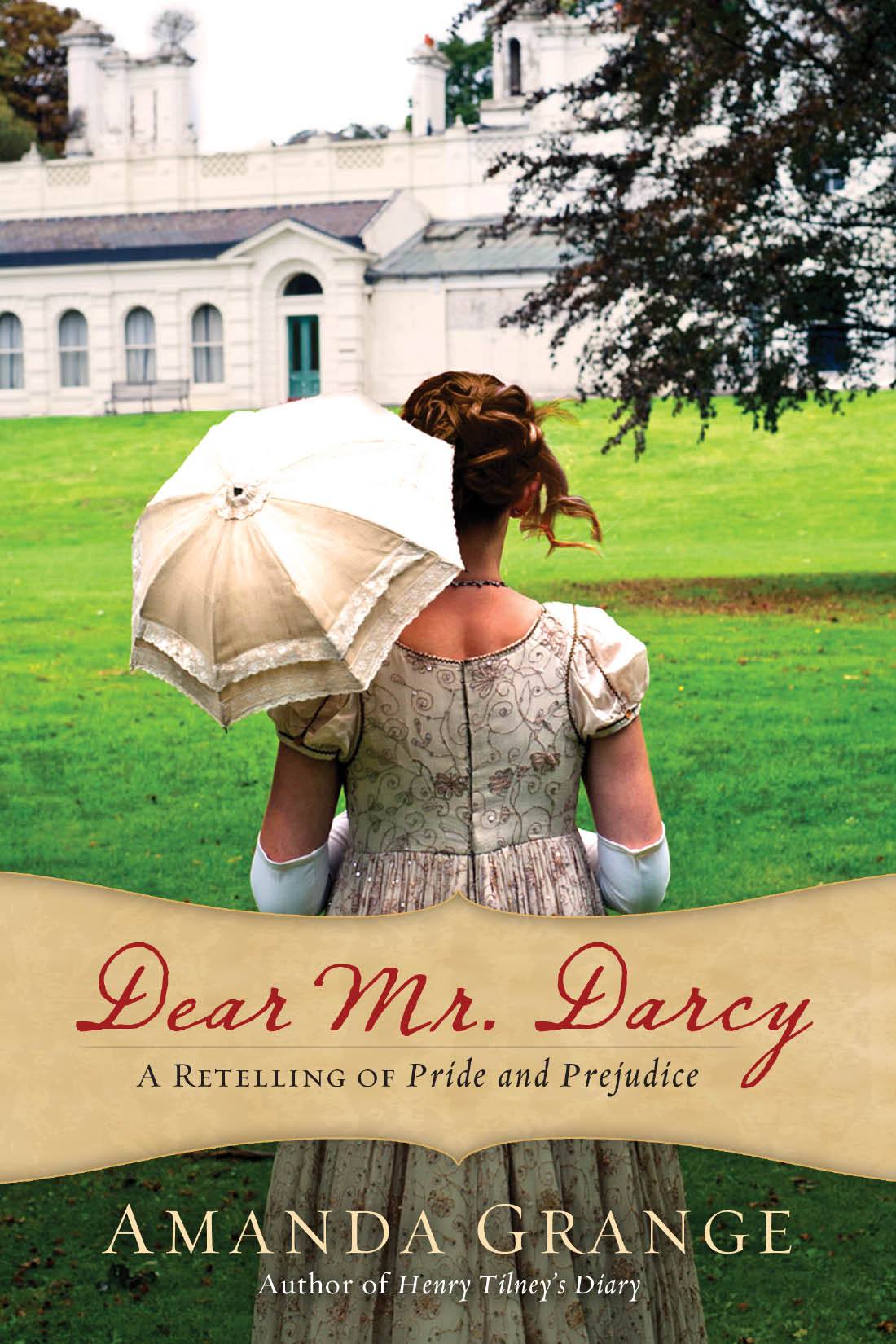
I think Grange's writing style is perfect for the letters. They read the way letters are written; none of the conversations are repeated verbatim as in the Diary, but are paraphrased. It loses a bit of the Austen zest, but it works better in this format; consider this extract from a letter from Louisa Hurst to her mother:
Mr. Darcy is as bored as we are. He refused to dance at the first assembly and although he was nearly forced into it a few days ago, for the sake of politeness, it all came to nothing, for when Sir William Lucas tried to encourage him to dance with Miss Elizabeth Bennet, she refused him. I am not surprised. Sir William had all but begged a partner for her and no one with any spirit would have acquiesced. It did her no harm in Darcy's opinion - quite the opposite. He was caught by her refusal and remarked later that she had fine eyes.I think Grange successfully captures each character's style; it helps that she has several letters from the book itself to work from. I particularly liked Mary's correspondence with with equally intellectually pompous Lucy Sotherton, who refer to themselves as followers of Athena and think that The Mysteries of Udolpho is a true history. Grange also throws hints in about Mary's clerk and Kitty's vicar and has a sweet friendship between Georgiana and Anne de Bourgh, despite the 12-year difference in their ages.
One small quibble is that I cannot imagine Darcy would write about his innermost feelings to anybody, although Grange tries to get around that by saying that his cousin Philip Darcy is the only one he would say such things to. It's necessary, of course, and Philip, who seems a right pompous prick, is the one who keeps reminding Darcy of how he would be abasing himself to marry Elizabeth, but still.
The major quibble is the treatment of the Bingley family. Charles's parents are made out to be bumpkins. Charles's father writes "I believe we were happier before all this tomfoolery, but your ma said as how we must have it now that the shop is doing so well. She's got me dressed up in a cravat and a tailcoat and I can't get comfortable in 'em." For the life of me I can't help reading that in Jed Clampett's voice, but only because I clearly did not watch enough All Creatures to get the Yorkshire accent in my head. Anyway, Caroline is made out to be just as forward as Lydia and nearly as vulgar as Mrs. Bennet, and the father is still in trade; Caroline receives a couple of set-downs because of it. It does give an interesting motivation for her being so rude about the Bennet family connections. But, just, No. All worlds of No. Insert "no no no" gif here. Because if that were the case, there is No. Way. that Darcy would even think about Bingley as a potential husband for his sister. Or would care so much about separating Bingley from Jane, because his family's position would actually be worse than the Bennets'.
Fortunately, this idiocy quiets down by the time the P&P action begins, and the rest of the letters are well done. The entire story comes across, and it doesn't seem forced or "I'm writing you this letter oh and hey let me tell you about this important plot point." A nice touch is that the last two letters are between Mrs. Jane Bingley and Mrs. Elizabeth Darcy.
Overall? Another good read for lovers of P&P, if you skip the Bingley bits at the beginning.
 |
| Image source: amandagrange.com |
In typing that, I just noticed that the structure of the book is past, present, future. Sort of. Okay, I'm probably stretching the point.
The story I liked best was the first one. Imagine a world where Darcy is too proud to ask Elizabeth to marry him again when she thanks him for helping Lydia. Insert Darcy's father as Marley's ghost, and Lady Anne Dary, Georgiana, and a rather gleeful Lady Catherine de Bourgh as the ghosts of Christmas past, present, and future, and it adds up to a cute story. It even turns out that Mr. Gardiner and Mr. Darcy play roles in Scrooge's story. And yes, there is a Timothy who says what you would expect him to say.
Christmas Present is kind of a meh story, I'm sad to say. It's more of a vignette than plot-driven, with a very pregnant Elizabeth heading (with Darcy) to the Bingley's new residence, Lowlands Park. If you are as genre-savvy as I am, you will know that the title is a bit of a giveaway as to what happens there. The Bennets (including a temporarily Wickhamless Lydia) are also guests. By an improbable coincidence, so are Mr. Collins and Lady Catherine de Bourgh. And really, not much happens.
The last story is a series of vignettes with a much older Darcy thinking back on all his Christmases since he met Elizabeth. There is more of a story structure here, as we get to meet their children and watch them grow up. There is joy and grief. It's very sweet, but kind of forgettable.
Overall? If you need some Darcy with your Christmas, read the first story. The other two are fine, but rather bland.
 |
| Image source: amandagrange.com |
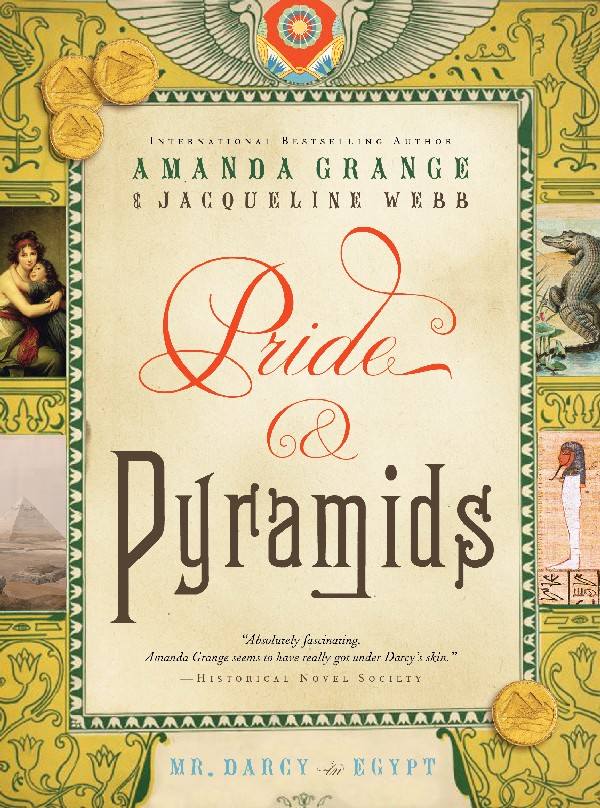
It is 1815, 16 years after the events of P&P and 6 years before Champollion will decrypt the Rosetta Stone. Edward Fitzwilliam, younger brother to Colonel Fitzwilliam, is very keen to get to Egypt because it turns out that his father and Darcy's father were there in their youth, looking for a tomb. They came back and refused to talk about it; Darcy's father's decline in health stems from this trip. Edward, younger son that he is, is anxious to find this tomb, both to prove himself to his father and to make his fortune. Darcy, naturally, thinks Edward should have nothing to do with it. However, Elizabeth is inspired by the idea and Darcy reluctantly agrees to organize an expedition including his five children, their nurses and tutors and governesses, various maids and footmen, the aptly-named painter Paul Inkworthy, and Sophie, the beautiful-but-recently-jilted youngest Lucas daughter. Oh, and Mrs. Bennet, who manages to invite herself along by dint of not getting off the boat in time. Even though she has no maid and exactly one outfit which would, no doubt, be completely inappropriate for Egypt. Meanwhile the youngest Darcy child, Margaret, has been enthralled by a doll of Aahotep who is unhappy because "...people were mean to Aahotep, so she was mean back." Oh, and when Wickham hears of the impending trip, he gets that special gleam in his eye which means he's Up To No Good.
It's a fun, fluffy tale. We get some nice interactions between the characters, and I like what Grange has done with the more mature Elizabeth and Darcy. They are still very much in love and still growing as people. My main problem comes from the blending of this adventure tale and Austen's characters, when Austen was so careful to set them in very ordinary settings. It doesn't quite fit. And then, a few things were set up that never got used later. I kept waiting for the other shoe to drop: would Inkworthy unknowingly betray his employer? Would Mrs. Bennet imperil them all? When was Wickham going to show up again? He does, but he's underused as a villain. Opportunities somewhat wasted, in my opinion.
My main issue is that this story could have been told with non-Austen characters and it would have been exactly the same. Which is a shame, because Austen is all about the characters for me.
So overall? Fun read, but kind of pointless as an Austen sequel.
 |
| Image source: austenprose.com |
"...I cannot see you doing well in a profession, George. No, I think you must cultivate the young men with heiresses for sisters. A life as a gentleman with a rich wife is more suited to you, I think."So we see how, over the years, he tries to ingratiate himself in with rich people, and feels himself very ill-used. He falls in with a bad lot, winds up in debtor's prison, and heaps abuse on Darcy when the latter will not give him the living he had formerly renounced. We see his foiled plot to elope with Georgiana, and the book ends with him hoping to meet his heiress in Hertfordshire.
If you haven't read Dear Mr. Darcy, then this is a nice complement to Mr. Darcy's Diary. I liked that we got to see Wickham's motivation for all his actions, and how his mother's advice shaped him. Once I got to the part that overlapped with the other story, though, it got a bit repetitive and I started skimming. This book also suffers from the I'm-going-to-transcribe-every-conversation-verbatim problem that feels just a bit off in a diary format.
Overall? Fun read, but only if you hadn't read the other book two days beforehand.
In general, Amanda Grange is a good writer with a good handle, for the most part, on Austen's characters.
Wow. I have read a lot of P&P books so far. They've been (mostly) fun, but I think I'm going to take a bit of a break from the printed page for a while and watch a bunch of movies and mini-series.
*I have already read it, but I'm leaving Mr Darcy, Vampyre until October. You have been warned.
**I have since read Henry Tilney's Diary and the writing out of entire conversations and passages from a novel really drove home the ridiculousness of it in the diary format. Especially since Henry gives examples of how people write in diaries: "Let me tell you what you ought to say: Henry home, booted and greatcoated - said that blue becomes me - admired the curl of my hair - disturbed me with his nonsense when I would much sooner be writing in my journal."***
***And may I just add here and now that, despite my fondness for Mr. Darcy and Captain Wentworth, Henry Tilney is my ideal Austen hero? He's so funny. And charming. And real. Sigh.


No comments:
Post a Comment
Now with less captcha! Speak pretty to me. I love comments, especially constructive criticism.