
The Annotated Pride and Prejudice, by Jane Austen, annotated and edited by David M. Shapard; Jane Austen's Pride and Prejudice: A Sourcebook edited by Robert Morrison
It's back-to-school time again, and I thought it would be appropriate to review some books that were both enjoyable and made me learn something along the way. I love annotated books, in particular when they were written in different eras. I have been guilty of applying modern sensibilities and motivations to the characters and missing cues that contemporary audiences would have immediately understood. I think it's easier to miss this kind of information in Austen because, unlike Shakespeare, the language of the 19th century was so similar to what we now use that we (or is it just me?) tend to think that meanings and attitudes must still be mostly the same.
 |
| Source: Amazon.com |
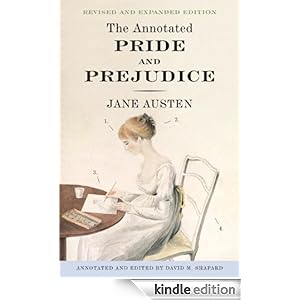
I got this book when it first came out nine years ago and I love it. There are two ways to use it. The first is to read it from beginning to end, reading the notes along the way. After a while, you'll notice that there is quite a bit of repetition; thank you, I heard you the first time you told me coloured meant blushed. But then you realize that it's designed for the people who use the book the second way (which group includes me, now): flip back and forth through the book, dipping into passages of interest.
This book is thick, because it's really two books in one. The text of the original is on the left-hand side, and there are notes of varying lengths on the right-hand side. They discuss everything from the meaning of a word in the 19th century to social mores to analysis of certain passages. As per the back cover, it contains more than 2300 annotations including "explanations of historical context; citations from Austen's life, letters, and other writings; definitions and clarifications; [and] literary comments and analysis." This stuff is wonderful. Even the front cover is annotated. What I really like about it is that it gives a lot of context for certain scenes. Readers in Austen's day would understand immediately, but often it is much less obvious to us today. For example, when Jane and Elizabeth are staying at Netherfield and Mrs. Bennet comes, Darcy's turning away from the woman wasn't considered rude:
What Mrs. Bennet does not appreciate is that Darcy's turning away in silence reflects his contempt for her, and was often considered to be the way a true gentleman should react to someone who was impertinent or ridiculous... Darcy's paying Elizabeth such a compliment, by debating her on important matters, is one sign of his genuine regard for her. pg. 79
Later on, it explains how dire Lydia's actions really were and how damaging they would be to the family, which is something I didn't truly appreciate before (again, modern sensibilities crept in).
Incidentally, that "shelves in the closets" thing they made fun of in the A&E version? Closets were small rooms, rather than cupboards, although the modern meaning was starting to take hold. So, you know, not so odd after all. Also, the bowing and curtseying seen in most of the adaptations are probably overdone; only Darcy, Collins, and Sir William bow in P&P. It was starting to go out of favour at that time and the bows were probably put in to show how formal Darcy was and how ridiculous the others were.
The book has a chronology, with a discussion of the errors in it and therefore the difficulty of placing the book in a particular year, maps (useful for those of us who are not quite as familiar with the English countryside), and an extensive bibliography. Sadly, no index. It took me a while to find certain passages: was that discussed during the evening at the Lucases or at Netherfield? Which only caused me pain in that I kept getting distracted by interesting bits of information.
To answer the questions above, there's a really good discussion about how difficult it is to translate early 19th century income into today's money, but looking only at inflation his 5000 pounds is about $300 000. The importance of Pemberley is not that she is awed by his wealth, but that the good taste and attractiveness of the house and grounds reveal a lot about the Darcy's character. Mr. Hurst could tell what Lizzy liked to eat because they dined à la française, that is, all sorts of dishes were put out on the table at once and people could choose for themselves. As for the barouche? See page 389.
All in all, I highly recommend this to those of us who want to see a lot more of the picture than just the Story.
 |
| Source: Amazon.com |
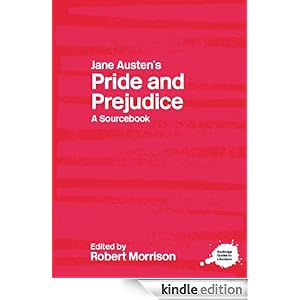
The book is split into four main parts: various writings that provide historical context for the novel, interpretations which include literary criticism (from contemporary to what other authors had to say - Mark Twain really didn't like the book - to modern criticism) and discussion of Darcy's portrayal in the 1995 version, key passages (annotated), and an annotated reference section. None of the selections is very long; most are 1-2 pages in total, so it's really easy to skip around. Each selection has a headnote from Morrison. Most of the time he merely summarizes the text and avoids adding his own commentary, saving that for the key passages.
I decided to not try to read this cover to cover and started with some passages that caught my eye in the Modern Criticism section. I was happy to see that Cheryl Nixon agrees with me that the 1995 Darcy was Byronic hero. In particular, a passage by John Wiltshire articulated some thoughts that were only half-formed in my head. Quoting from Morrison's headnote summary:
Elizabeth and Darcy project their own resentments and wishes onto one another. Each is a part of the other's psychological landscape, but neither is present to the other as a distinct being... For both, the self only sees the self, and their relationship is mired in solipsism until each perceives in the other a vital and separate presence. pg. 96The selection itself is both more clear and detailed and a better use of psychoanalysis than the Freudian interpretation a few pages earlier. There's a fascinating bit by Steven Scott about how Mary was the first real disappointment to the Bennets because she should have been a boy. Most of the selections are interesting, and there are only few that I, in my humble and relatively uneducated opinion, think are rot (content-wise, at least).
Three of the passages are devoted to Colin Firth and the 1995 Darcy. The longest section in the book is actually an excerpt from an interview with Firth, which was interesting given my recent rewatching. I'm a total nerd about finding out why actors/authors/whoever chose to do certain things or what they were thinking and how it informed the scene, and this interview gives a lot of that. No discussion of all the water, though.
And Cheryl Nixon agrees that Davies turned Mr. Darcy into a Byronic character. I knew it.
By the way, I was surprised to read that there have been seven film versions (nine, now; the book was published just before the 2005 movie came out and certainly before The LBD). I can think of only four (six). Plus two if you include Bride and Prejudice (which you should, because it's terrific) and Bridget Jones. Not having access to his reference, I'm a little stuck on the last one. Wishbone? The Latter Day comedy? Is there, in some bizarre and inappropriate twist, a silent version?
The contemporary and other novelists' criticisms are quite diverse - from Mark Twain's shinbone to Henry Cray Robinson, who "stayed up till two" to finish the book. I appreciate Morrison's including the negative reviews as well as the good; like the Elizabeth and Darcy, it's important to be reminded of the (in my view minor) flaws of the story to keep the fans honest.
The contemporary documents at the beginning are well-chosen, I think, to set the scene, but this is the part that I more or less skimmed. I hope to go back someday and read them more thoroughly. Here, Morrison does more than merely summarize the text, but offers commentary on how they may have informed certain passages in P&P. Likewise in the Key Passages section, which focus mainly on the relationship bits, he offers not only his interpretation but others', referring back to the appropriate pages in the earlier sections. In fact, there is a lot of cross-referencing throughout, which I find very helpful.
A great resource. Thank you, whatever happy accident led it to show up in my TPL search results!


No comments:
Post a Comment
Now with less captcha! Speak pretty to me. I love comments, especially constructive criticism.