
So, I really meant to pace myself with this challenge. One book/movie/audiobook a month. Nice and steady. No need to get it all done right away, right? Even if I have shown myself to be a wee bit of an overachiever in the past?
Yeah. Is there a category above Aficionada?
I was in the middle of reading the second sequel to P&P by another author when I got a hold of this trilogy. It's been on my reading list for years. I dipped into it, just for a second, you know, just to see how it was. Then I just kept right on reading. And I'm still in the middle of the other sequel.
So, this is P&P from Darcy's point of view, and it's generally well-done. It can get a bit repetitive and I think the second half of the second book is completely unnecessary, but overall the trilogy is well worth the read. Aiden is quite clever about taking the occasional throw-away remark and turning it into a whole scene where we get to see what makes Darcy tick, occasionally blending it with known dialogue from the original. A few liberties are taken, naturally, but they don't detract. After I finished them, I went back and reread the first and last books side-by-side with P&P - it was fun in a she-said-he-said kind of way. The difference is, of course, that while Austen did give us a little of what Darcy (and certain other characters) were thinking, Aiden gives us only Mr. Darcy's POV.
Her take? Beneath the froideur of Darcy's mien boils a great deal of passion. This is not a new suposition - I think that most of us who love Mr. Darcy despite the fact that he seems to be a chilly prig do so because we know that the chilly prigness hides a powerful feeling, tightly reined in; we also want to be ardently admired and loved.
I do have a few problems with the non-second-half-of-the-second-book parts; from Darcy's point of view, Elizabeth is near perfection and it gets a bit grating. I mean, fine, let the character put her up on a pedestal, but allow the reader to see some of her faults. It also got on my nerves when they kept calling her "Miss Elizabeth" to her face. Even when she was the only Bennet in the room. Which you wouldn't do. Particularly someone as correct as Darcy. And then, as I said, it gets a bit repetitive - we get it, Darcy, you think Elizabeth is bewitching, she has auburn curls and brandy-coloured eyes, and you finger her talisman to bring her to mind. And his private thoughts are a little over-full of exclamation marks. There is also a bit of silliness with his valet. The whole thing could have been tightened up and put in to two books, much like the original. But these are fairly minor annoyances, and I enjoyed the rest enough that they didn't ruin the books.
 |
| Image source: wikimedia.org |
“Mr. Darcy is all politeness,” said Elizabeth, smiling in anticipation of emerging from this encounter the winner.At Netherfield, he is so bewitched by her that when he finds some embroidery threads she had knotted together to form a bookmark, he keeps this token in his waistcoat and handles it often. This despite the fact that her low connections mean that he can't think seriously about her as a wife. It's kind of sweet.
“He is, indeed: but considering the inducement, my dear Miss Eliza, we cannot wonder at his complaisance; for who would object to such a partner?”
It was a question for which neither party was prepared to venture an answer. Elizabeth looked at Darcy archly, eyes sparkling in triumph and, murmuring her regrets to Sir William, turned away. Although disappointed, Darcy could not help but admire her poise and amusement in the awkward situation into which they had been drawn. Miss Elizabeth Bennet was so much more than he had expected to encounter in the savage hinterlands of Hertfordshire.
The book ends with Darcy and Bingley returning to London after the Netherfield Ball, at which Darcy reached his limit: the mention of Wickham tends to send him through the roof, and the behaviour of Elizabeth's family is the final nail in the coffin. He has to separate both Bingley and himself from this pernicious influence before either of them do something stupid.
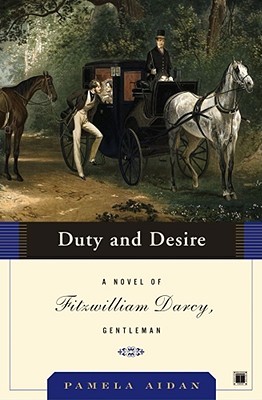 |
| Image source: goodreads.com |
I will be honest: I got to the point in this book just before Darcy announces he is suddenly going away for a week, and then peeked at the start of the third book because I wanted to know where it started. I was very surprised to discover that it begins as Darcy and Fitzwilliam are going to Kent - which is the middle of P&P. I wound up reading the third book before I finished reading the second. I don't feel I lost anything by it.
The first part of the book is quite nice; we learn more of the relationship between Darcy and Georgiana, see a little bit how Bingley is suffering from lack of Jane, as well as Miss Bingley's attempts at conspiring with Darcy. Georgiana gets Darcy to open up a bit about his feelings for Elizabeth and wishes to meet her. Darcy tells her that he's fairly certain that will never happen. I have a hard time reconciling this mature, confident lady with the extremely shy person Elizabeth meets at Pemberley, but I mostly like what Aiden did with the characters here.
Her hand turned in his and squeezed it briefly. “I have tried to be content with your wish for privacy, Fitzwilliam, and not tease you. But so often you are distracted. A certain look crosses your face, and I sense you are thinking of her.” She blushed as he started at her assertion. “At least, I believe that is so.”Once the Darcy moves on to the house party, though, it's like we've been dropped into a completely different novel. It's weird. And a waste of time. I read it with more than a trace of impatience. I didn't care about anybody at the house party or what happened to them. My advice? Skip it. Some of these characters show up again in the third book, but they don't really add anything to the plot or to understanding Darcy's character.
“Distracted? How so? I am sure you must be mistaken,” he denied swiftly, but it did not dissuade her.
“Were you not, just now, dreaming of Miss Elizabeth?”
 |
| Image source: goodreads.com |
“Yes, yes, that would be the Darcy approach, wouldn’t it? No need to pander to the lady’s sensibilities now, is there?” he offered in tart sarcasm. “Her attractions had prevailed over the inflexible Darcy canon, and what was more natural than that she be made to know her extreme good fortune and how little she deserved it!” Laughing humorlessly into the dangerously narrowed eyes Darcy set upon him, he smacked the table, setting the coffee to dancing. “Yes, only you, my friend, would make the lady’s general unfitness the leading topic in a proposal of marriage. Pray, enlighten me! Which of your scruples led you into such a confession?”At which point Darcy realizes what a jerk he's been to not just Elizabeth and starts making changes.
We next see him just before he meets Elizabeth at Pemberley. He is anxious to show her how he has changed, and to introduce her to Georgiana. He realizes that he never really loved her properly before now, because before it was all about what he wanted and now it's all about her. Even though he doesn't know how she feels. Then the Lydia-Wickham *&$# hits the fan, and instead of thinking how this would affect him, all his concern is for Elizabeth and her future prospects. What he does, he does to give Elizabeth a chance at future happiness, even if it is not with him.
He thinks he will never see her again, when Bingley tells him he still has Netherfield. Up again go his hopes, and every thing hastens to the not-at-all vexatious conclusion.
The third book is quite good, barring the unnecessary and silly spy/political intrigue subplot (which, I assure you, is quite brief and fairly easy to skim should you wish). I really liked what she did with Darcy in Kent; I always wondered how he could believe Elizabeth to be wishing, expecting his addresses, but Aiden deals with that in a very believable way. Her writing is not as elegant as Austen's prose, so sometimes going between Austen's dialogue and his inner thoughts is a bit odd, but on the whole she deals well with the scenes that Austen only describes.
So, to sum up: a good read. Skip the second half of the second book and skim the bits in the first and third books where he goes to parties in London.
I now return myself to my regularly-scheduled reading, already in progress.
By the way, I forgot to publish my post on the End of the Lizzie Bennet Diaries last week, but it's there now.


Hola! I've been meaning to read this trilogy for ages, but it's not one of the cheaper ones so I haven't got round to it yet! I enjoyed your review.
ReplyDeleteThanks! I know what you mean. Fortunately, Toronto has an excellent library system -- although why they only have *one* copy of the first book but 10 and *19* copies of the others is beyond me...
DeleteThat's bizarre! My library doesn't have them, boooo.
ReplyDelete